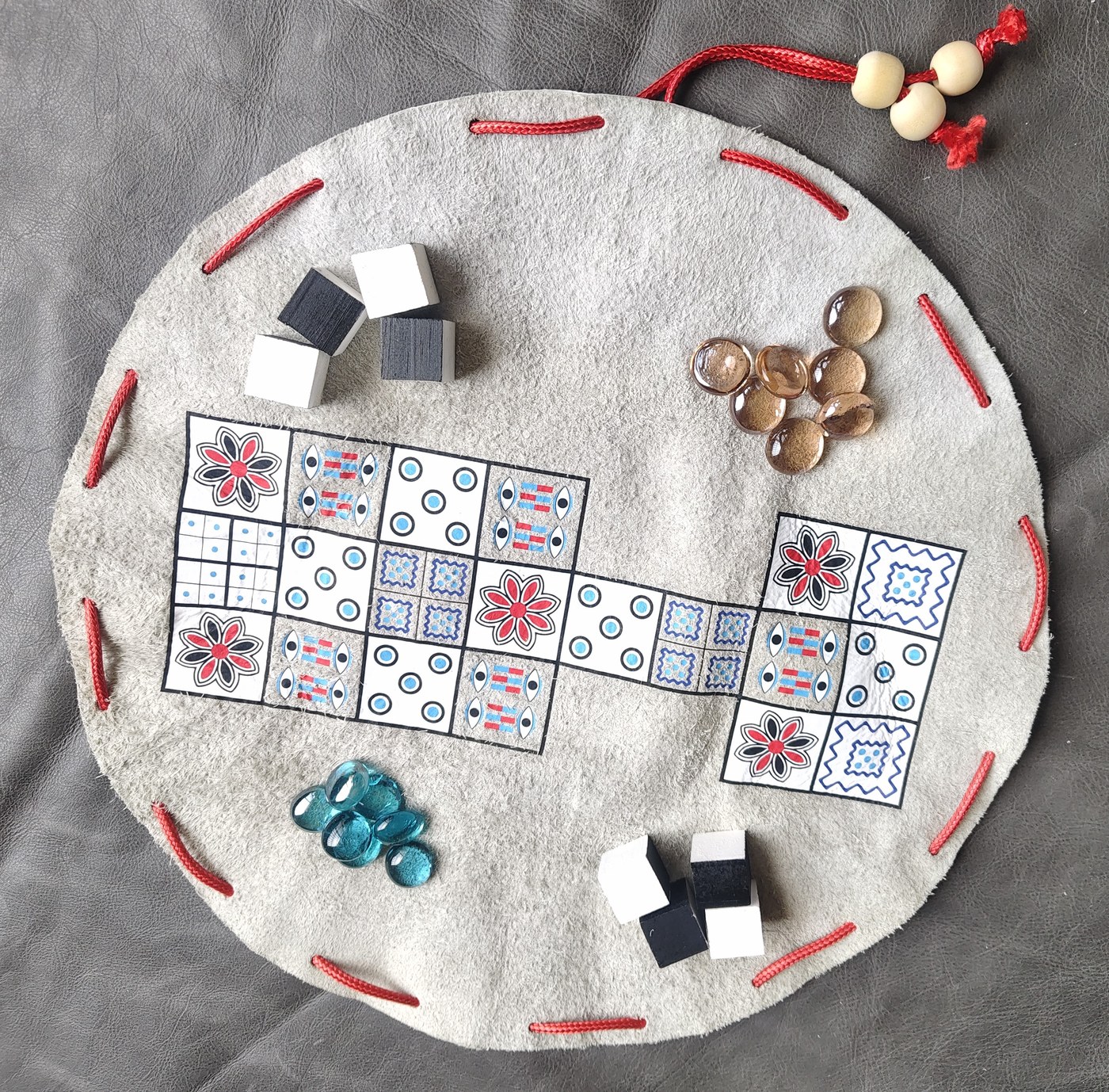
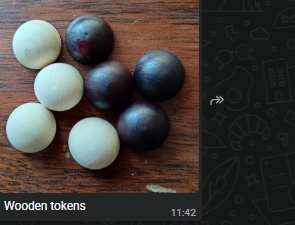
Showing our 20-square rosette layout on genuine leather with 14 counters and four binary wooden dice.
The 4,600-Year-Old Race of Kings & Sacred Rosettes
Buried in the Royal Cemetery of Sumer and deciphered from Babylonian cuneiform tablets by Dr. Irving Finkel at the British Museum. A thrilling contest of tactical risk along a contested central raceway.
Around 4,600 years ago, people in ancient Mesopotamia were playing a game that would eventually disappear from living memory.
Beautiful game boards were buried in the Royal Cemetery at Ur, in what is now Iraq. One surviving example in the British Museum dates to approximately 2600–2400 BC.
For thousands of years, the game remained a mystery. Then British Museum curator Dr. Irving Finkel deciphered a Babylonian cuneiform tablet containing information about how the game was played. This allowed the Royal Game of Ur to be reconstructed and played again in the modern world.
Move all seven of your pieces along the course and safely off the board before your opponent.
This is one of the most interesting aspects of Ur.
We have considerably more evidence than we do for Senet, thanks to the deciphered Babylonian cuneiform text. However, modern versions do not all agree on every detail. For example, different reconstructions have used five or seven pieces, and there are differences concerning the precise route and the treatment of certain rosettes.
When you play the Royal Game of Ur, you are participating in one of the rare board games for which archaeologists have been able to reconnect an ancient game board with written evidence about how it was played.
The ancient game used specialised throwing dice/lots, including tetrahedral dice in reconstructed versions.
For The Heritage Game Company edition, we use four wooden binary dice, each with three white sides and three black sides.
This is not historically accurate in physical form. However, the binary principle is deliberately retained: each die produces one of two outcomes, and the total determines the number of spaces a player may move.
This gives the game a practical modern form while retaining the spirit of its ancient method of chance.
| Players | 2 Players |
|---|---|
| Board | 20-square shaped layout with rosettes on genuine leather leather mat |
| Pieces | 7 per player (14 pieces total) |
| Dice | Four binary wooden dice (three white / three black faces) |
| Playing Time | Approximately 20–30 minutes |
| Difficulty | Easy to learn / Moderate to master |
| Historical Confidence | ★★★★☆ — based on ancient British Museum Babylonian cuneiform tablet |